For modern Western medicine, the science it’s founded on is developed exclusively from rigorously evidence-based facts. Objectivity is a discipline of this system, and unproven theories carry no weight. Surmises, analogies, speculation and comparisons between unconnected phenomena, are all invalid in the modern Western medical approach. But look at all the different medical systems that have served humanity over millennia, and one will see that through the vast majority of history, healers have sought knowledge and insight into the mysteries of health, and life in our world in general, by a great many roads. Cosmology, astrology, and alchemy have provided ways of looking at the physical world. Political study, theology, philosophy, and even war manuals like The Art of War have informed earlier physicians as to subtleties and relationships within the human body, as much as these same works informed thinkers about the complexities of the natural world and between human beings.
In trying to understand the mechanisms at work in a complex, living, and constantly changing human being in issues of health and morbidity, it makes sense to consider the big and the complex picture. A range of models of knowledge provides many ways to understand a problem when it comes to a human seeking wellness, and for thousands of years health systems around the world did just that. Fortunately many of these ancient health care approaches are still with us, and being practiced.
Traditional Chinese/East Asian Medicine (TCM) is extremely rich in such contributions from the diversity of human thought. One idea which acts as a cornerstone of TCM theory is that of Yin/Yang. This is its common image:
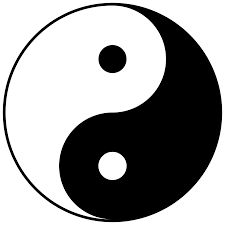
Yin/Yang is essentially an analogy, a concise picture of what may be the most common pattern observable in our world, that being hot/cold or day/night. The classic example of Yin is Water, and that of Yang is Fire. In the picture, Yin (cold, water) is black, while Yang (hot, fire) is white. In the picture, the Yang ascends like fire, and the Yin settles like water. Each also carries the seed of its opposite. What does that mean? Imagine fire rising from a hearth. As its flames reach their apex, ashes will fall down towards the earth again. Imagine water, which in the world usually feels cool or cold, and is dense and displaces most other substances. And yet water is teeming with life (a very Yang phenomenon) and stores heat from the atmosphere. And there is another aspect to the image to consider when it comes to interconnectedness. Yin and Yang are both contained within a circle, symbolizing that they are simply parts of a whole, despite their apparent differences.
Another example of Yin/Yang, which also vies for being the most classic such example observable in the world, is life and death, or animate and inanimate states of being. As with fire and water, each of these carries the germ of its opposite within it. Living things must one day die, and decay over time into something like soil–therefore, Yin can come from Yang. Conversely, living things can appear to generate spontaneously from something inanimate, like worms from soil, or flies from rotting fruit, so that Yang comes from Yin. In this same vein, living things made lifeless or inert through harvesting and cooking are consumed and make a living body strong and healthy, so that Yin Nourishes Yang. The implications can seem confounding, suggesting the “chicken or the egg” conundrum. But the image of white and black fish within the circle reminds us that there is no answer to that inquiry, and no need for one. The dichotomy has always been present, and will continue to be part of the world, each part depending on the existence of the other, in a beautiful harmony.
It’s important to understand that, in thinking about Yin/Yang, no single thing can be said to be Yin or Yang unless it is compared to something else. Water without fire (or another substance) for comparison cannot be more or less Yin or Yang. It is all relative: therefore, there must be a point of comparison. However, one substance can be compared to itself if two examples in different conditions can be compared. For example, ice can be considered Yin compared to steam. Or, a stone on a mountainside may be said to be more Yang than one lying in a stream in a valley, either because of its elevation (“Heaven” being Yang) or because it is more likely to move by rolling downhill: it has more of a chance of being animate, if only for a moment . . . . An empty bottle or plate would be more Yang, having potential for the function of storing water or food, while if it is full, it’s replete and heavy, and more Yin.
Considering the analogy abstractly, one can imagine these two principles applying to all sorts of situations. As a philosophical idea, and in TCM theory, Yin/Yang becomes a way to look at any two separate things, or constituents of one thing, in a relative way. To put it another way, Yin/Yang is a tool for comparing and understanding the relationship between things, or among parts of a single thing.
In TCM theory, one main application of Yin/Yang is in the understanding of the organ systems. The organs as understood in TCM are Heart, Pericardium, Lung, Stomach, Spleen, Liver, Gall Bladder, Large Intestine, Small Intestine, Kidney, Urinary Bladder, and Triple Burner. Generally these correspond to the organs of Western anatomy, at least in location. But to understand their relationships within the body system, TCM theory divides them into Yin organs (Zang) and Yang organs (Fu). The Yin organs, also known as the solid organs (Heart, Lung, Pericardium, Spleen, Liver, and Kidney) are considered to be reservoirs of Essence, Body Fluid and Blood, the product of the body’s processes derived from food and air taken from outside, as well as the inherited life-force and health of one’s ancestors. If one compares this sort of stored wealth to a savings account, that gives a good idea how these organs are understood. What is deposited into the Zang organs is intended to be kept there, building up solidity, stability and strength. If anything is drawn from them, this happens in response to great need, whether a lack of ample resources in the environment or other stresses and demands from life.
The Yang organs (Fu) also called the hollow organs (Stomach, Small Intestine, Large Intestine, Gall Bladder, Urinary Bladder and Triple Burner*) are said to serve to move substances (food and water) through the body so that each of the Fu can perform its function of extracting what the body needs to create Essence, Blood and Body Fluid. While the Fu deal with coarser materials (which would seem Yin in the sense of darkness, earth, etc), what is more significant is that they are dealing with taking in and transforming substance from the outside world, which is Yang in comparison to the hidden, discrete, and less active world within the body’s storehouses.
These organs, Zang and Fu together, relate to one another (understood through Yin/Yang) and in ideal biological function, their inter-workings are smooth and harmonious. This ideal situation becomes a guide for returning health to a patient, which the acupuncturist uses to determine patterns of imbalance and choose prescriptions to return the body to good function. While things can become very complicated to understand, the rigorous training of a TCM healer ensures their clear view of priorities, integration with other medical approaches, and the big picture of health, to find the way to support a client’s return to good health.
*Note: Several anatomical organs are not counted the same way in TCM, for example the brain, reproductive organs, skin, etc. The pancreas, for example, may have been understood to be a part of the TCM Spleen, if one looks at the functions of Spleen especially regarding digestion, water metabolism, and the taste corresponding to Spleen (sweet!). In another example, the brain is called the Sea of Marrow, a extension or reservoir of Essence, a very important form of Qi (or life energy). In fact the entire body is considered and worked into the TCM biological picture, only on its own terms and often described through metaphor. Very little of TCM theory is derived from cadaver study, and a great deal developed from disciplines of meditation, introspection, observation and energetic ideas. To see a special insight of this approach, look at the strangely-named organ named in the article above: “Triple Burner” (or San Jiao). There is no organ like this in Western biology. The Triple Burner is the summation of the orchestrated activity of the entire body’s ability to create, transform and move the fluids of the body. The Triple Burner is really about the miracle of complex life forms and the ability of the body to work together seamlessly. The ancient doctors recognized this phenomenon, and though they found no one organ that seemed to be responsible for it, they still named it, acknowledged its existence, and strove to understand it in such a way that they could return it to proper function when it appeared to be out of balance.
 Peoples Community Acupuncture Collective Nola
Leave a comment